AI vs traditional answering service
Which answering service fits the calls your business receives?
Traditional services use human agents working from scripts. AI services use automated voice for supported conversations. Compare both on the calls that require nuance, current business data, booking authority, and escalation—not only on whether a call gets answered.
In CrewBrix
Explore an example workflow
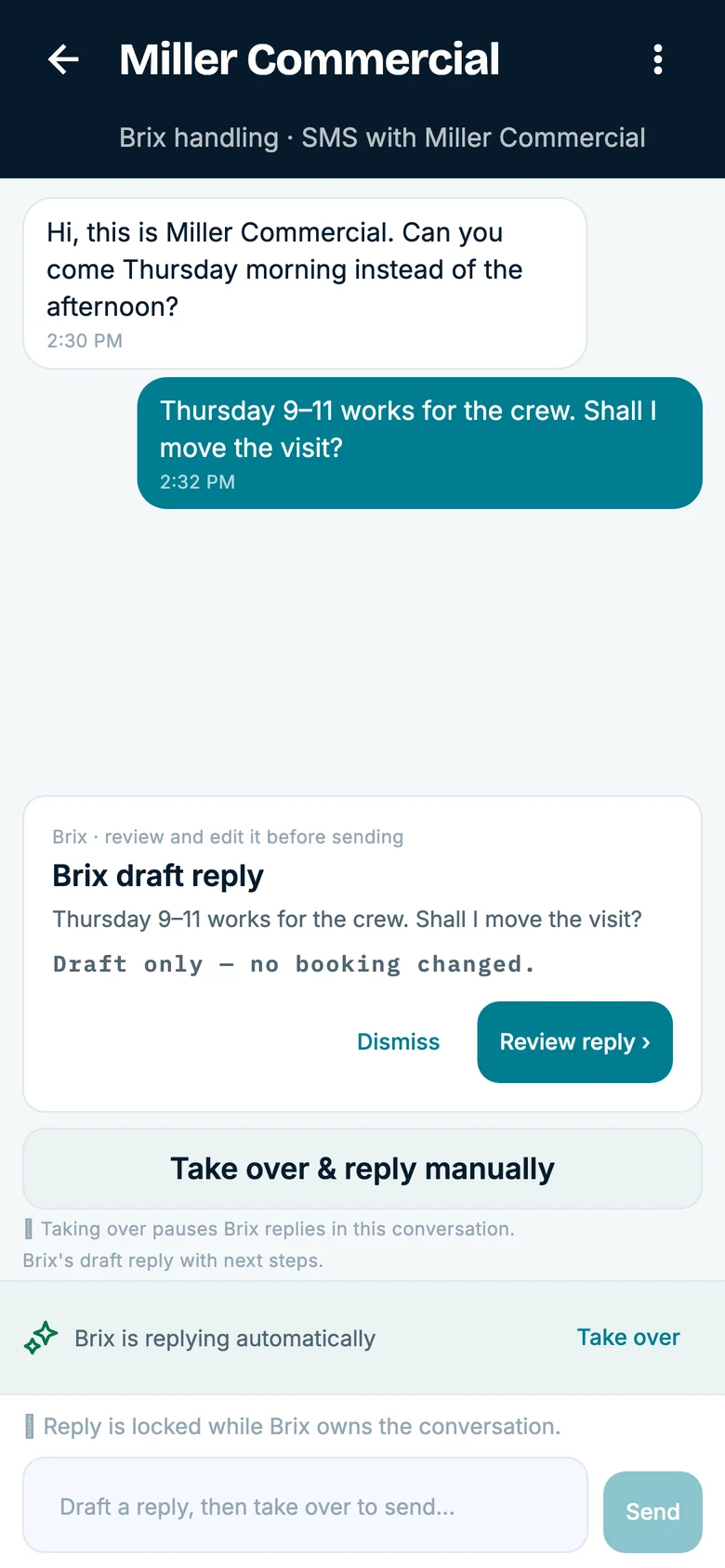
Keep the customer’s request and Brix’s prepared reply in the same conversation.
Try the same difficult call with both services
- 01
Returning customer
Ask the caller to describe an existing job imperfectly. Check whether the service can identify the customer and pass useful details to the office.
LimitDo not assume access to equipment or job history. Verify the connected data and permissions for each service.
- 02
Price or arrival request
Ask for a price and an arrival time that are not preapproved.
LimitNeither a person nor AI should invent a commitment. Confirm the approved response and who takes over.
- 03
Full calendar
Request a time that is unavailable and inspect the resulting booking, task, or message.
LimitA request is not an appointment until booking succeeds against current availability and rules.
- 04
Safety or technical question
Use a question that requires judgment beyond the intake script.
LimitDo not allow technical or safety guidance outside an approved policy. Confirm the escalation contact and fallback.
- 05
Next morning
Review the caller, request, notes, next action, and owner in the system your office uses.
LimitIf the provider supplies only a message, include manual entry and follow-up in the cost comparison.
What to compare
- Conversation quality
- Human agents may be stronger on nuance; automation may apply configured intake more consistently. Test both with routine and ambiguous calls.
- System connection
- Ask which current customer, schedule, and job data the service can use and exactly where its output appears.
- Escalation
- Name the person who receives urgent or unclear requests, the information they receive, and the fallback if they do not respond.
- Keeping details current
- Check who updates hours, service area, prices, and policies and when those changes take effect.
- Total cost
- Include setup, plan or staffing fees, usage, overflow, integrations, and the work required to resolve exceptions.
Questions about this call workflow
Is an AI answering service better than a traditional answering service?
Not for every call. Compare the conversations you actually receive, system access, escalation, coverage, and total cost. Test ambiguity and exceptions as well as routine intake.
Can an AI answering service replace every human call?
No. Sensitive, unclear, unsafe, or unauthorized requests still need a person. Confirm how the service passes the conversation details and who owns the next action.
How does CrewBrix approach AI call handling?
CrewBrix supports configured AI call workflows alongside customer, schedule, and job data. Exact voice, booking, and escalation behavior depends on plan, configuration, current data, and approval settings.
Test the calls that need a person
Bring the returning-customer, price, full-calendar, and safety cases your office receives. Review the data, approved response, escalation contact, and next-morning record before choosing a service.